

The Nemean Lion — Heracles’ First Labour
Continuation of the story The Labours of Heracles.
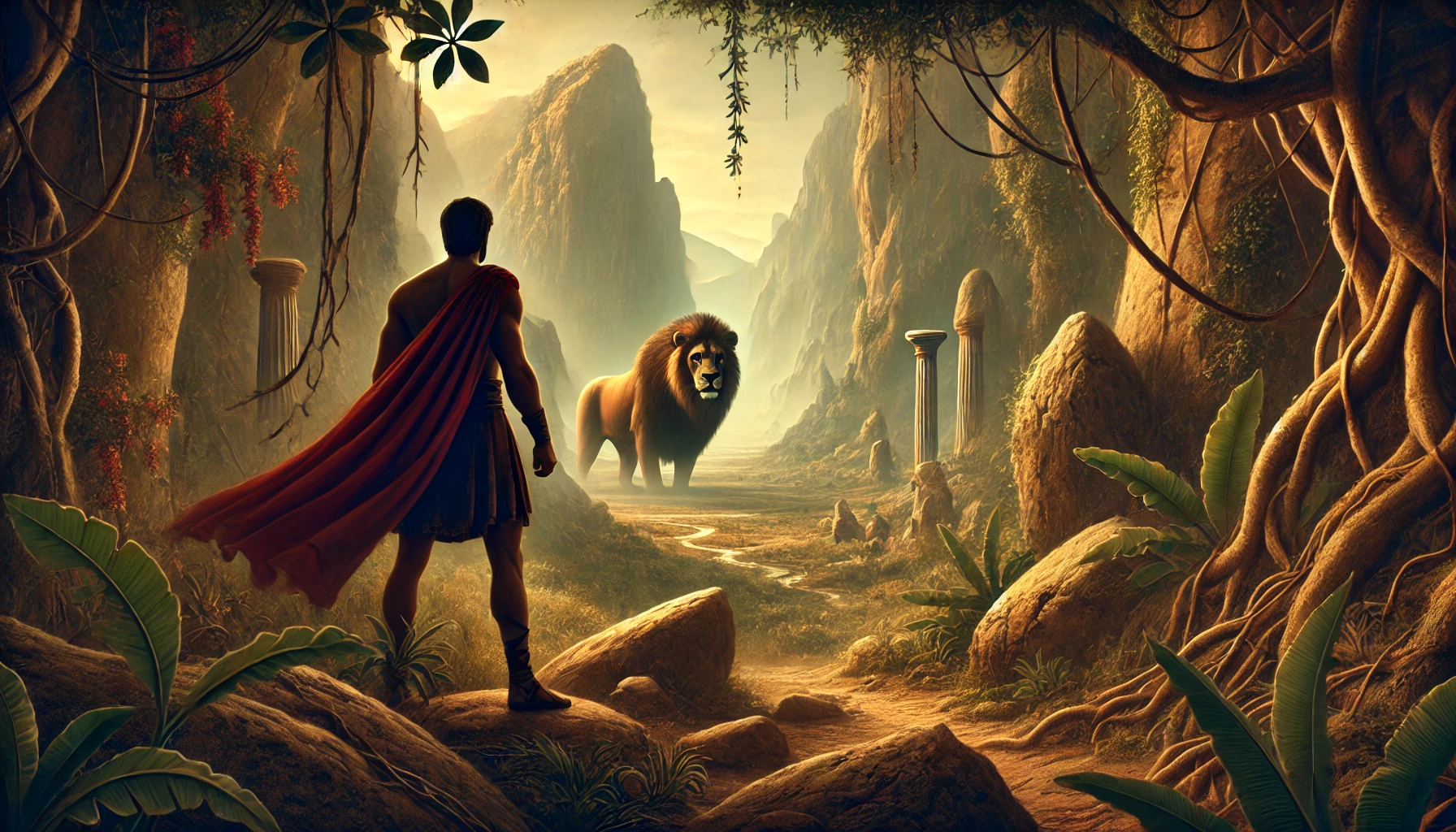
The first labour assigned to Heracles was to slay the Nemean Lion. The question was: how does one kill an invulnerable animal?
Everyone in the country knew which area to avoid. This was no ordinary lion, but a direct descendant of the monstrous Chimera. The beast, with divine attributes, boasted a golden hide so thick that spears and arrows rebounded off it as if they were straw. Its claws, as sharp as swords, could pierce armour as though it were mere paper. And its jaws, strong and powerful, allowed it to crush rocks as if they were crunchy nuts.
All the people living in that area, from Nemea to the north-east of the kingdom, were deeply terrified by the havoc wrought by the lion. Fear of the beast deterred all travellers from approaching those lands and also discouraged merchants from trading with the entire region of Argolis.
Facing the creature meant certain death, plain and simple. No warrior had returned. Thus, Eurystheus did not hesitate to assign this task to Heracles, hoping to witness the end of the hero.
The King’s Orders
King Eurystheus relished the thought of Heracles’ suffering. For a long time, he had harboured hatred, envy, and resentment towards his cousin, as he neither possessed Heracles’ attributes nor enjoyed his reputation.
“Make your way to Nemea,” Eurystheus told Heracles, “and slay the lion that is ravaging the land.”
“Just kill it?” asked Heracles. “Don’t you want me to bring it back?”
Amid the laughter of his courtiers, the king responded with a smile:
“And what would I do with a lion? No, I do not want you to bring it to me!”
Heracles stood up, bowed, and left the throne room.
“He may have arms like oak branches, but his brain is the size of a walnut,” the king scoffed in a final burst of contempt.
Underestimating Heracles’ cunning and judgement was sheer foolishness, as would soon become clear.
A Strength Worthy of the Gods
Heracles knew that facing a lion was no easy task. He could draw on his experience of killing the lion of Thespis years earlier. This time, however, the risk and complexity were much greater.
To carry out the task, he began to track and spy on the beast. It was crucial to understand its movements, learn how it hunted, and assess its speed and brutality. He did this for months, day after day. He could not afford any margin for error and had to be prepared. Even so, he was well aware that his weapons, formidable and of divine origin though they were, would not suffice to stop the beast. He would have to rely solely on his bare hands and his strength. Thus, in addition to spying, he spent all that time training, preparing for combat. He did this by tearing trees out by their roots and lifting and throwing large stones overhead until he achieved a strength worthy of the gods.
When he knew he was ready, Heracles followed the trail of the lion, stealthily, until he reached its den.
A Deadly Embrace
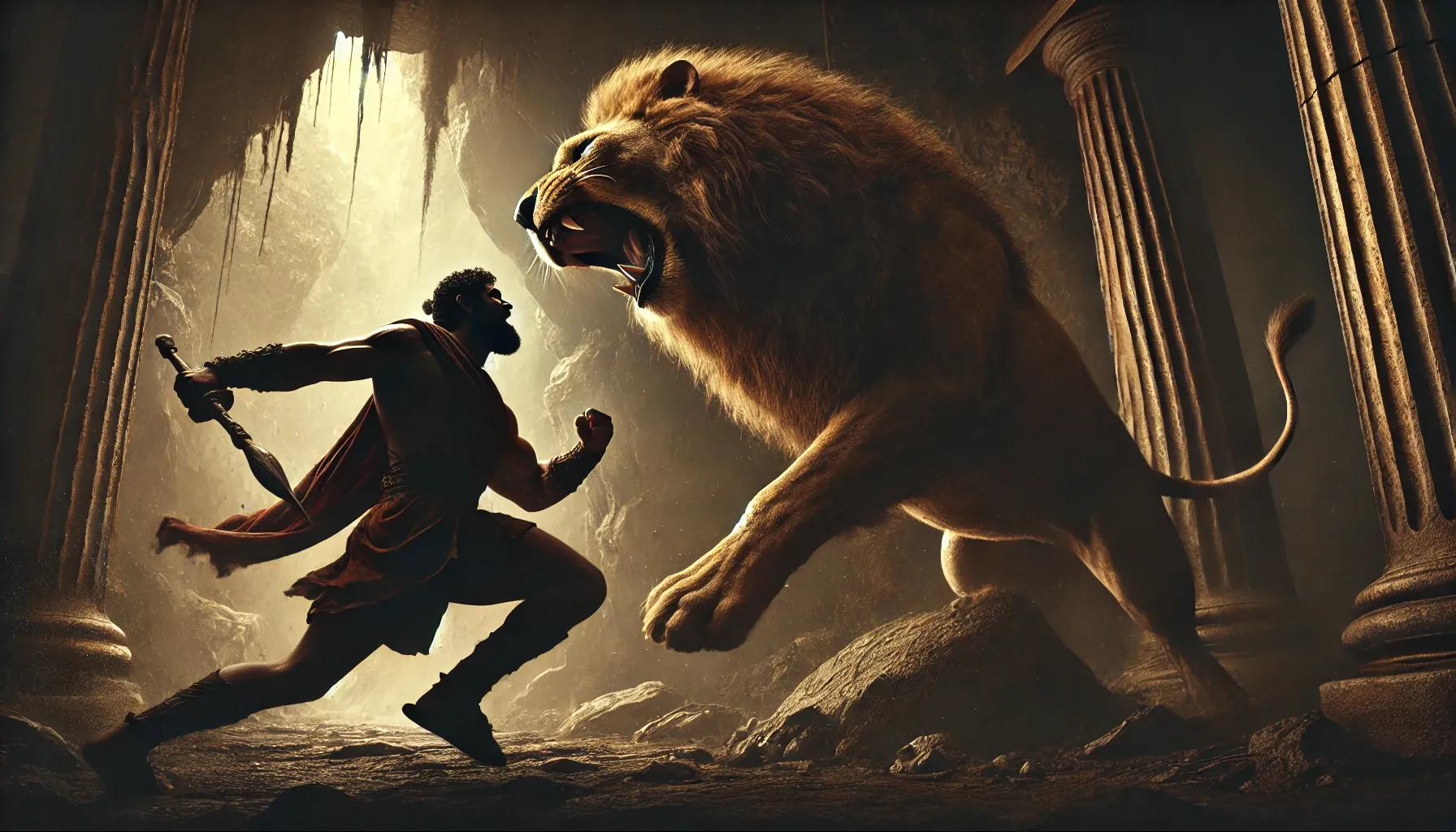
Moving in complete silence, Heracles managed to position himself just metres away from the lion. Then, as he had planned, he lunged at it with such brutality that the roles of predator and prey seemed to be reversed. No one had ever dared attack the lion in such a manner before.
The impact knocked the lion to the ground. Heracles did not want to give it a chance to react or recover. He could not afford to step back lest he become a victim of its claws or jaws. With an unyielding motion, he formed a loop with his arms around the lion’s neck and began to squeeze as tightly as his position allowed.
The lion rolled him across the ground, trying to shake Heracles off, but the embrace was so solid that all the blows Heracles suffered and all the lion’s struggles were not enough to break the hold. Gradually, the movements began to slow down. The lion resisted, but the lack of oxygen was beginning to weaken it. Heracles took nothing for granted. He continued relentlessly until, after more than an hour, the lion exhaled its last breath.
Sacred Armour
After the battle, Heracles stood upright beside the corpse and bowed his head.
“It was a fair fight,” he said. “I only hope you did not suffer. I apologise for now having to mar your body.”
Heracles, a man of honour, always showed great respect for his adversaries, even when, as in this case, they were wild beasts. Whenever possible, he wanted to send them to the other world with all the honour and ceremony they deserved. The tougher the fight, the more profound and reverent the tributes.
He remembered how Eurystheus had belittled the body of the lion once it was dead. Heracles, however, recognised the animal’s sacredness. Its body was not merely a trophy; it was a pledge, a gift that he had earned after the epic battle.
He did not know how to cut the skin since no weapon could penetrate it. In a sudden apparition, Athena, goddess of wisdom, craftsmanship and war, inspired Heracles to use the lion’s own claws to make the cut.
Thus, he made himself armour from the indestructible hide of the lion and a necklace from its claws. With this new attire, he began the journey back to the king’s castle. His first labour had been completed.
Continues with The Lernaean Hydra.
Continue exploring
Reading list
- Labours of Heracles. Wikipedia, the Free Encyclopedia.
- Fry, S. (2018). Heroes. Penguin Books.
- Hamiltor, E. (1942). Mythology, Timeless tales of Gods and Heroes. Little, Brown and Company.
- Graves, R. (1955). The Greek Myths. Penguin Books.