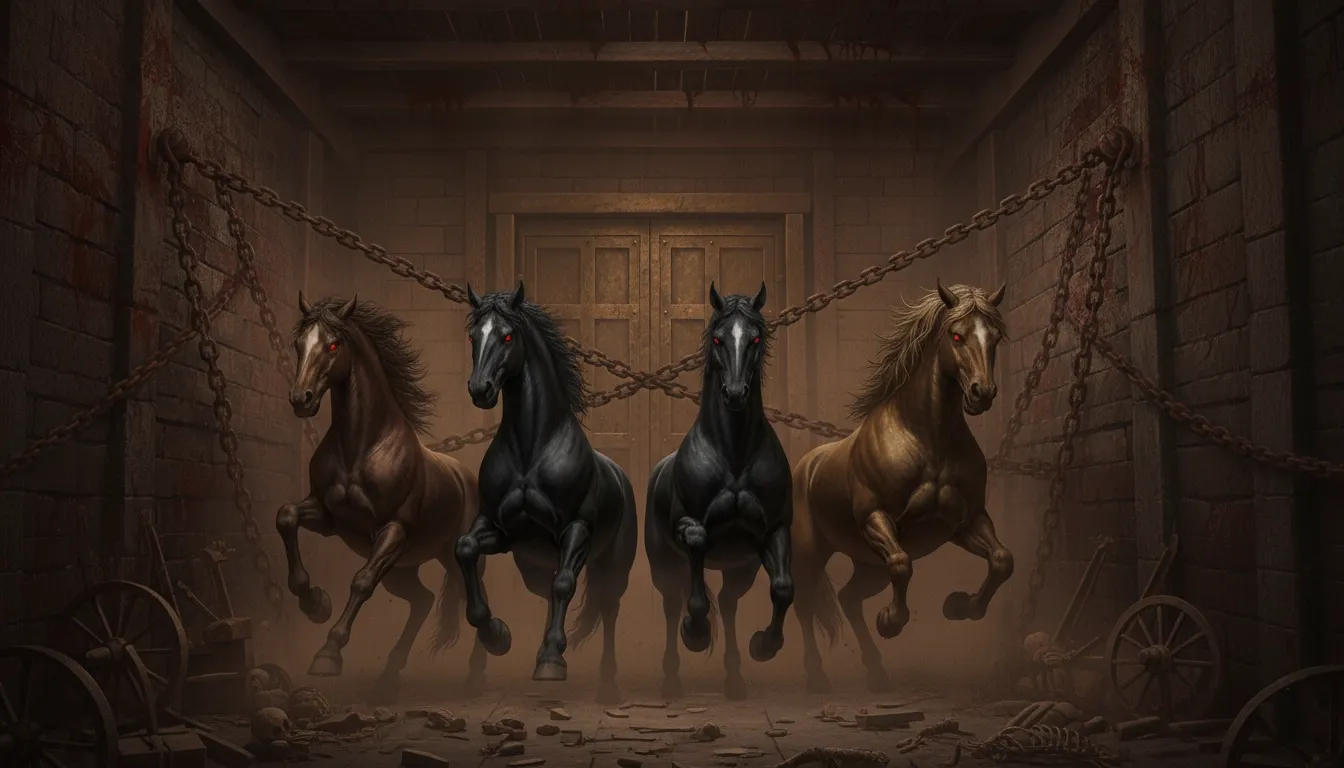

What you feed grows: lessons from Heracles’ eighth labour
Complements the story of the mares of Diomedes.
You have probably felt, more than once, that certain kinds of problems keep following you. You might think you are unlucky, or even that someone has put some sort of curse on you. Sometimes, though, part of the problem lies in what we keep feeding without realising it.
We want to reduce stress, yet maintain a pace of life that never lets us switch off. We want to put an argument behind us, yet replay it in our minds again and again. We want to give up a bad habit, yet keep surrounding ourselves with the things that draw us back to it.
It is a contradiction as human as it is common. The outcome troubles us, yet we often leave the causes that sustain it untouched.
Habits, emotions and even conflicts have something in common: what we repeat tends to become more firmly established. Each time we feed a behaviour, we give it a little more strength. And something that seemed small at first can end up taking far more space than we ever imagined.
The story of the mares of Diomedes takes this idea to a monstrous extreme.
Diomedes, king of the Bistonians and son of the god Ares, kept wild mares that fed on human flesh. These were not simply dangerous animals that had appeared by chance. The king himself had cultivated their brutal nature by feeding them in this way.
When Heracles arrives in Thrace to capture them, he faces more than ferocious beasts. He faces the result of years spent deliberately feeding a destructive force.
Feeding the monster
No monster stays alive without something to feed it. The mares of Diomedes had become terrifying creatures because someone had reinforced that behaviour again and again. In this reading of the myth, the cruelty of the person feeding them comes to define the mares’ behaviour.
It is an idea that readily translates into everyday life.
Anger grows when we constantly return to the memory of an offence. Envy strengthens when we continually measure our lives against other people’s. An addiction becomes more entrenched each time we give in to the impulse that feeds it. Even the ego can come to distort us when it constantly needs recognition, power or admiration to remain satisfied.
This does not mean that every negative emotion is bad in itself. The problem arises when we make it a regular source of nourishment. Repetition can reinforce the pattern.
Diomedes did not find monstrous mares. He raised them that way.
And this is probably the myth’s first great lesson: what you feed grows.
The boomerang effect
In the version followed by our story, the symbolism becomes even stronger when Diomedes is devoured by the very mares he has spent years feeding with other victims. The image is as extreme as it is meaningful.
Diomedes believed he controlled the mares. He decided what they ate, who kept them confined and who used their ferocity for personal gain. Yet he had created a force that no longer understood loyalty, ownership or control. In the end, the monster makes no distinction between master and victim.
This kind of boomerang effect often recurs in real life.
- Ambition can help us move forward until it begins to demand more time, more sacrifices and more compromises than we are willing to make.
- Resentment may seem like a way of preserving the memory of an injustice, yet it can end up affecting the person holding on to it more deeply than the person who caused the offence.
- The need for control can begin as an attempt to protect ourselves and end by making us slaves to everything we try to control.
The pattern is much the same. First, we feed a force because we believe it serves us. Then we need to keep feeding it because it has become part of us. Finally, we risk letting it begin to feed on us.
Diomedes becomes a victim of the very behaviour he had encouraged.
What you feed may end up feeding on you.
The cost of losing control
Yet the consequences of our monsters do not always fall on us alone.
During the capture of the mares, Heracles temporarily entrusts the animals to his companion Abderus while he confronts Diomedes’ men. Still wild and far from truly subdued, the mares attack Abderus and kill him.
This episode introduces another important idea: capturing a problem does not mean solving it. If its cause remains untouched, the problem persists.
Heracles had managed to seize the mares, but he had not yet tamed them. The destructive force that Diomedes had fed for years still existed, and Abderus paid the price.
This may be one of the hardest consequences of our own problems to accept: they do not always affect us alone.
Poorly managed anger can end up hurting the people close to us. An obsession can consume the time we once devoted to others. An addiction can disrupt an entire family. Boundless ambition can turn the people around us into mere obstacles or instruments.
When we allow a force to grow unchecked, we also lose the ability to see how far its consequences will reach. And when they finally become visible, they may be far worse than we ever imagined.