
The Seed of Discord: Lessons from Heracles’ Ninth Labour

Complements the story of the girdle of Hippolyta.
How often have you changed your opinion of someone because of something another person told you? A comment taken out of context. A rumour. An intention no one has checked, but which everyone suddenly takes for granted.
Sometimes, a single piece of false or exaggerated information is enough for harmony to begin to unravel. The most unsettling part is that the lie does not need to be particularly sophisticated. It only needs to sound credible enough for someone to act on it.
When that happens, reality no longer depends solely on what is happening. It also becomes shaped by what each person believes is happening.
The story of Heracles and the girdle of Hippolyta is probably one of the clearest examples of this mechanism. A journey that could have ended in a peaceful agreement. A labour that, for a few moments, was already all but complete.
Yet harmony turns into tragedy.
The cause? False information introduced at just the right moment by someone who knew exactly what effect it could have.
A Conflict That Did Not Exist
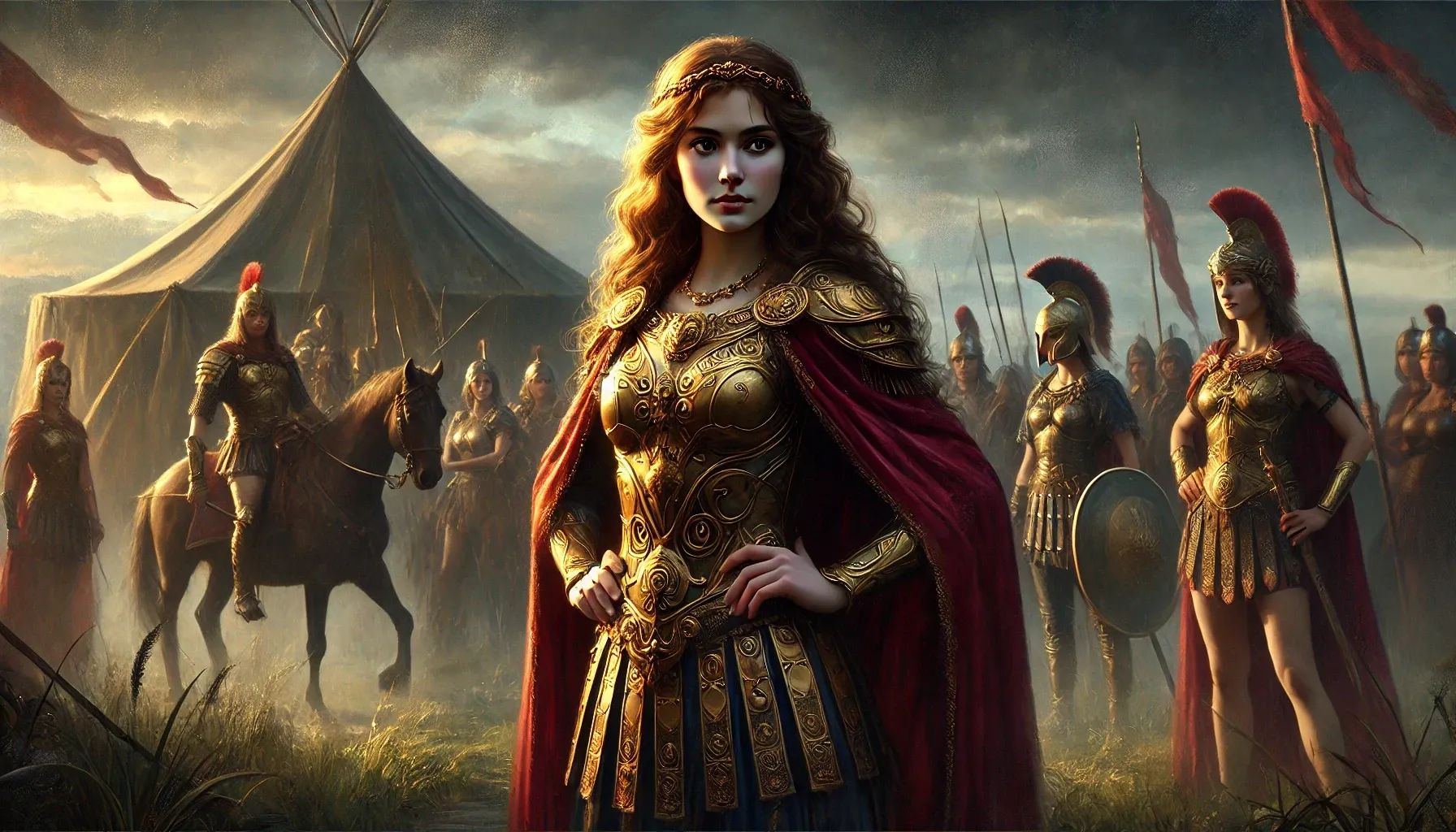
Heracles travels to the land of the Amazons to obtain the girdle of their queen, Hippolyta. It was a possession of great symbolic value, associated with her power and authority among the warriors.
Faced with a people known for their military strength, it would be easy to imagine that Heracles would have to fight another battle to obtain it, or steal it in secret to avoid one. Yet the story initially takes a very different direction. Hippolyta welcomes the hero and listens to the reason for his journey. After speaking with him, she agrees to give him the girdle. No fighting. No deception. No need to impose his will by force.
The situation matters because it reminds us of something we often forget: not every conflict we anticipate actually comes about. We often build up a confrontation in our minds before we have even attempted a conversation, an agreement or a negotiation. Heracles arrives prepared for a difficult mission, but talking had been enough.
The problem, then, does not arise because Heracles and Hippolyta want incompatible things. It arises when a third party decides to distort the information passing between them about what is happening.
The Danger of Rumours
Hera, still trying to hinder Heracles’ labours, takes on the appearance of an Amazon and spreads an alarming message among the warriors: the stranger who has arrived in their land intends to abduct the queen.
The information is entirely false, but the context makes it credible. The Amazons belong to a warrior people and know that any powerful community has enemies. They also know that attacking their leader would be one of the most effective ways to hurt them. And at that moment, Hippolyta is not among them.
Suddenly, a baseless lie begins to take on the appearance of truth.
From their perspective, the Amazons are not acting irrationally. They believe they must protect Queen Hippolyta from an immediate threat. The problem is that, although they are acting on a false premise, the consequences of their response will be very real.
This is one of the most interesting aspects of the story: we can make a perfectly coherent decision and still reach a completely mistaken conclusion if the information we base it on is false.
Humanity has witnessed this reality time and again. Rumours that have destroyed reputations. Propaganda that has turned groups of people into enemies. Incomplete information that has led to hasty decisions. Today, the speed at which information travels amplifies this risk even further: we often react before we have had time to ask ourselves whether what we have just read is true.
Hera’s rumour works because it changes the Amazons’ perception. Heracles is no longer a visitor. He is a threat.
And as the Amazons arm themselves and head towards him, that first mistaken perception is about to feed another.
When We React Faster Than We Understand
Heracles sees the Amazons approaching, ready for battle, and interprets the attack as a betrayal. From his point of view, Hippolyta had only pretended to reach an agreement while her warriors prepared an ambush.
His conclusion is wrong, but the evidence before him seems to confirm it. This is how many conflicts begin to escalate.
One person misinterprets an action. They respond defensively. The other sees that response as an act of aggression and reacts more forcefully. Each new action confirms the other side’s suspicions, until the initial misunderstanding is buried beneath a succession of increasingly hostile responses.
In the myth, the outcome is tragic. Heracles ends up killing Hippolyta and takes by force the very girdle she had already agreed to give him willingly.
This is probably the great irony of the story.
The entire conflict ends up achieving exactly the same result that had already been reached without any need to fight. The problem had not been a lack of agreement. It had been the failure to check what had changed before reacting to it.
This lesson is especially useful when an unexpected conflict arises. If someone who seemed to be acting in good faith suddenly changes their behaviour, perhaps our first question should not be how to defend ourselves, but what has happened to make the situation change so quickly.
Perhaps there is information we do not have. Perhaps there has been a misunderstanding. Or perhaps someone, like Hera, has decided to introduce a self-serving version of events.
Hippolyta’s story reminds us that information has power because it shapes the way we interpret the world. When that information is false, even a response that seems reasonable to us can lead us in the wrong direction.
So, before reacting to someone’s intentions, it is worth making sure those intentions actually exist.
A lie does not need to be true to have real consequences.