

The Augean Stables — Heracles’ Fifth Labour
Continuation of the story The Erymanthian Boar.
With the first two labours, Eurystheus had thought he could finish Heracles off. That was not the case. It became clear that he had underestimated him, as Heracles ended up conquering the formidable creatures. If the hero were merely a brute of savage strength, he would not have succeeded in the next two tasks either. Nevertheless, the live capture of the two animals, in Ceryneia and Erymanthos respectively, was also successfully accomplished.
This time, Heracles’ new mission would be different. The king wanted to frustrate him, to make him suffer from stress. Although the next task posed no danger, its complexity lay in the sheer amount of work, combined with the limited time to accomplish it.
The king quickly sent him west to the city of Elis to clean the Augean stables. He couldn’t do it at his own pace, but would only complete the task if he managed to clean them in a single day. The challenge was set.
The Putrid State of the Augean Stables
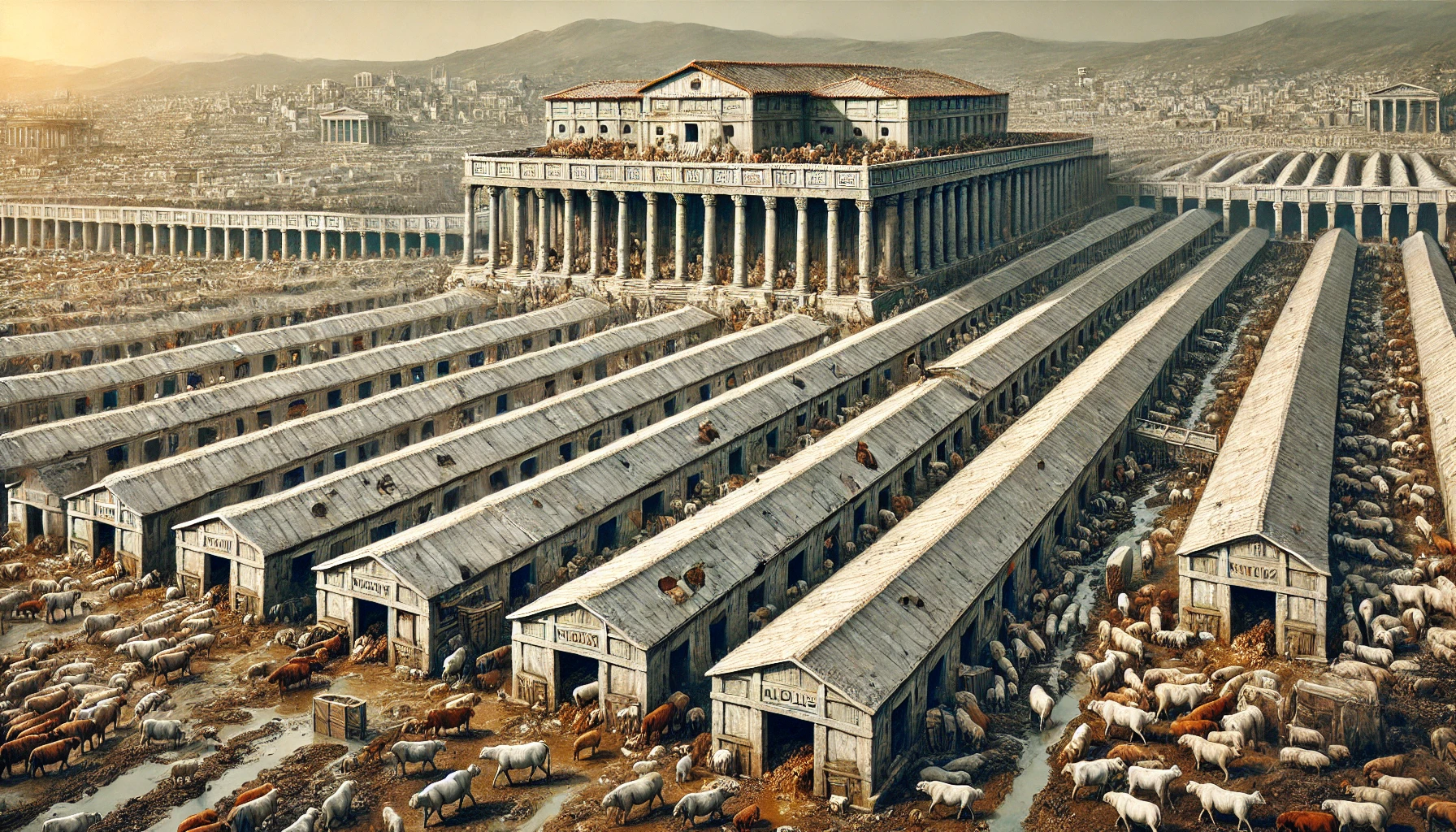
King Augeas did not have ordinary stables. He boasted livestock with divine properties, meaning they were immortal. In total, he owned more than three thousand head of cattle. The accumulation of dung was enormous, as the stables had not been cleaned for over thirty years.
The stench of all that manure could be smelt from miles away. Heracles was aware that this task posed no danger, but it was surely designed to make him suffer severely. He would do whatever was necessary to complete the task. Nevertheless, it seemed as if there was a touch of malice intended to humiliate him: leaving that dung heap spotless by removing endless excrement with very little time to finish.
Before starting the work, he requested an audience with King Augeas. He had a plan in mind.
A Task with a Reward
The royal guard escorted Heracles to the court. Once before the king and his advisers, he spoke up.
“Your Majesty, King Eurystheus of Mycenae has sent me here, to your city. By the order of the king and the will of the gods, I ask your permission to clean the stables of your divine livestock.”
“Indeed, I would never have imagined the gods would send me such an offer,” responded King Augeas. “It must be that the gods cannot bear to see such praiseworthy livestock suffer in such a dilapidated structure. And who are you, you poor knight, to have suffered such a punishment?”
“My name is Heracles, son of Zeus and Alcmena, from the kingdom of Mycenae.”
Upon hearing the name, Phyleus, Augeas’ son, who stood among the advisers, raised his head, delighted to see the hero he already admired.
“So you are the revered Heracles, whose fame has spread to the four winds?” said the king before pausing. “Has your king, Eurystheus, asked for anything in return for such labour?”
“No, Your Majesty, it is the will of the gods. My king merely conveys their decree. I must complete the task alone, and I must do it in one day.”
“Son, you know what you have done to deserve such a penance, but not even a son of Zeus could accomplish such a feat. Are you aware of what you are saying?”
“Your Majesty, if it did not seem impossible, such a task would not have been assigned to me. With your permission, I would like to make an agreement with you.”
“Go ahead. I’m listening attentively…”
“If I manage to clean your stables thoroughly between sunrise and sunset tomorrow, would Your Majesty allow me to keep a tenth of the livestock?”
There was a moment of silence while the king and the advisers looked at each other. King Augeas could not believe what he was hearing. While it was true that it was a bold request, the chances of losing were minimal. “Between sunrise and sunset.” Not even a full day to clean that mountain of manure from the stables. It was certain that Heracles could make some progress, but not complete the task. In the king’s eyes, it was an impossible feat; therefore, there was no risk of losing livestock.
“I must confess that it is bold to ask me for such a reward,” he responded. “But for your bravery and because it would be a great gift if you succeeded, I accept the deal. I recommend you rest well tonight, for tomorrow you have much work ahead.”
Just as Heracles wanted, the king accepted his proposal. His plan was unfolding. Now it was time to rest to face the great challenge.
A Deluge of Manure
At dawn, Heracles headed straight for the stables. He had paid close attention to the kingdom’s lands while making his way there. He began to put the second part of his plan into action. With determination, he made his way through the manure to reach the first wall of the stables, which faced the foot of the hills. Thanks to his extraordinary strength, he began to punch holes in the wall at several points.
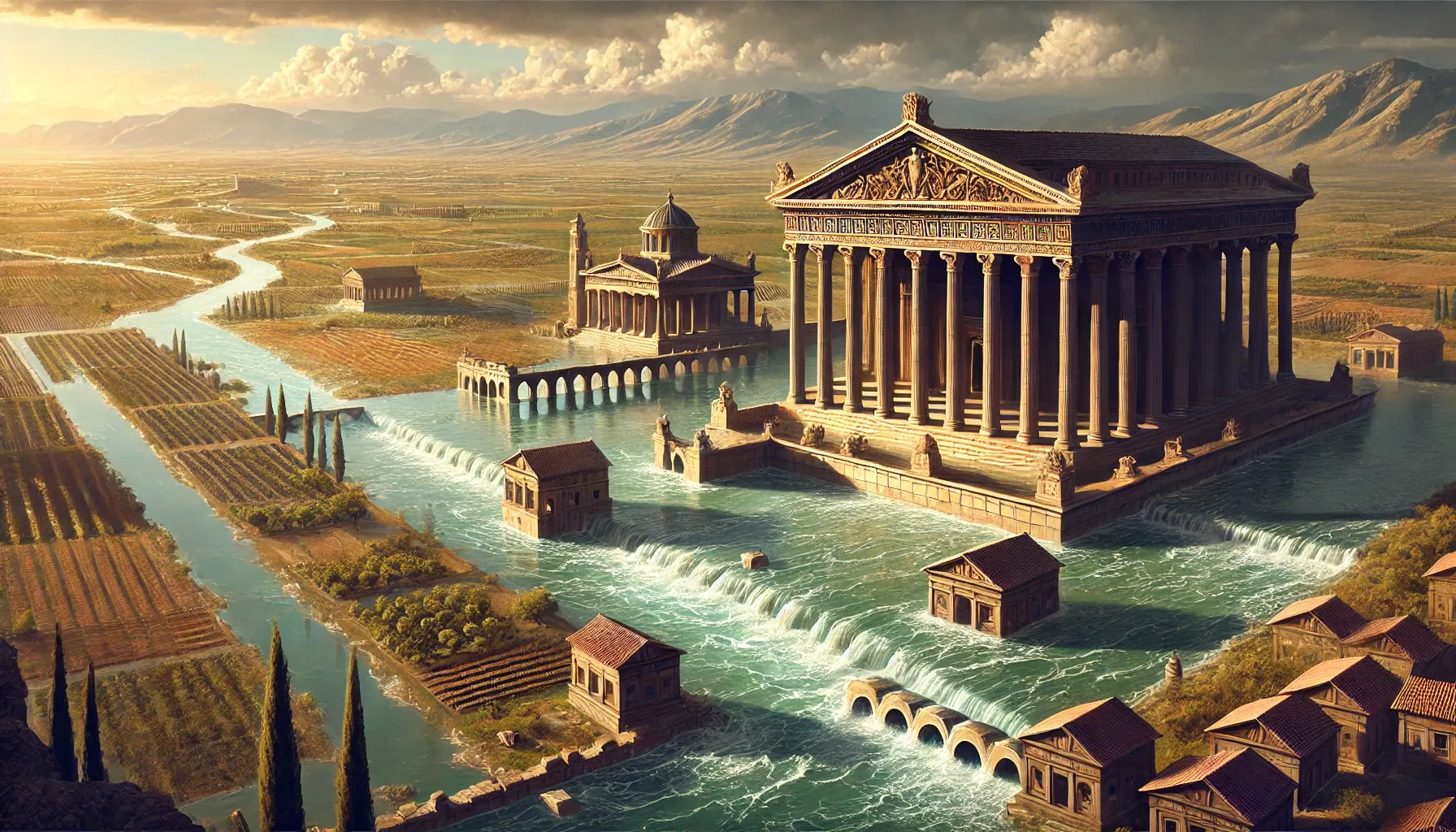
Once satisfied, Heracles climbed the first hill. On his way to the kingdom, he had noticed that two rivers, the Peneus and the Alpheus, passed through the area. He approached the first river and, using his great strength again, began moving large stones into the middle of the current. As the large rocks were added, the course was altered to direct it where he needed it.
The water flowed directly towards the stables area. Pleased with what he had accomplished, Heracles headed towards the second river. He repeated the process, altering its course to direct it at will. The two rivers now surged towards the stables. As expected, the water began to carry away the surrounding manure. Thanks to the holes he had made in the wall, the water entered the enclosures to also sweep away all the filth inside the structures. Now, all that was needed was patience.
The large amount of water descending from the two torrents did not stop at the stables. It continued downwards, carrying all the manure and spreading it throughout the valley of Elis. All the fields surrounding the city were irrigated and fertilised as a result.
Once there was no more dirt to remove from the stables, Heracles decided to restore the original courses of the two rivers. He undid the change so as not to alter the environment of the area.
Royal Disloyalty
Heracles returned to King Augeas’s throne room to receive his reward. The task had been completed in less than a day, just as he had predicted. The king should have been pleased with the result, and Heracles should have been rewarded with the three hundred head of cattle promised in their agreement. However, the situation did not unfold as Heracles had envisaged.
The king was in a foul mood. He was aware of everything and couldn’t imagine that Heracles would actually complete the task. He valued his livestock so much that he did not want to part with any of it.
“Your Majesty, as I promised, I have left the stables spotlessly clean. I present myself before you again to confirm this and to receive the reward we agreed upon.”
“Your reputation is well-earned, young Heracles. I hardly expected you to achieve such a feat,” the king responded, carefully choosing his words. “However, you told me this task was a divine mandate, carried out under the orders of your king…”
“That is correct.”
“In that case, it means you have performed this task as a slave. I see no reason why I should pay a slave for fulfilling his duty.”
“Your Majesty, we reached an agreement!” Heracles replied, irritated. “Your Majesty accepted the agreement just yesterday! It is only right to demand that you keep your word.”
“I made no such agreement! My counsellors here are my witnesses.”
“You did accept the deal, Father!” Phyleus interjected, outraged. “I was there and heard it perfectly well.”
The king cast an angry glance at his son. While he had his counsellors firmly under his control, he hadn’t expected his own son to expose him.
“There’s nothing more to discuss!” the king shouted, rising from his throne. “Guards, escort this young slave out of the city. I never want to see him within my kingdom again. And you, if you want your own livestock, sort it out with your king!”
“I did not expect such baseness from you,” Heracles retorted. “I will leave, but this will not end here!”
“Out of my sight!”
Heracles was expelled from Elis. For daring to expose Augeas, Phyleus, his own son, was also banished from the kingdom.
The hero left the royal court enraged by the lack of respect shown to him. However, his mood quickly changed when he was greeted with joy and gratitude by the people and farmers of Elis. His feat had enriched the kingdom’s fields and promised a fruitful season. His fifth labour had been completed and celebrated with enthusiasm!
Continues with The Stymphalian Birds.
Continue exploring
Reading list
- Labours of Heracles. Wikipedia, the Free Encyclopedia.
- Fry, S. (2018). Heroes. Penguin Books.
- Hamiltor, E. (1942). Mythology, Timeless tales of Gods and Heroes. Little, Brown and Company.
- Graves, R. (1955). The Greek Myths. Penguin Books.